

Facelift and neck lift surgery with Dr. Henry Sandel
Facelift
A facelift here includes the neck lift. Dr. Sandel lifts the deep layer of the face and tightens the neck in the same operation, so the result is a defined jawline rather than tight skin.
At a glance
Surgeon
Dr. Henry Sandel
Procedure time
Typically 2 to 2.5 hours
Anesthesia
Light anesthesia
Setting
West Annapolis Surgery Center
Sutures out
Day 7
Full activity
Usually at two weeks
Results last
7–10 years, typically
Facelift and neck lift in Annapolis with Dr. Sandel
Facelift techniques have advanced dramatically in recent years. While this procedure formerly made only superficial alterations, today’s techniques allow surgeons to make deeper, longer-lasting changes. Dr. Sandel lifts the supporting layer of the skin to contour the lower face and neck together, removes the excess skin hanging in the upper and mid-neck, and lifts the jowls to sharpen your jawline, producing a more natural-looking result.
Skin-tightening creams, chemical peels, injectable fillers, and Botox can counter the early effects of facial aging, but a facelift and neck lift is a more effective and longer-lasting solution when your skin becomes too loose for these remedies.
A facelift can reverse
Sagging skin on the face and neck
Jowls and loose, hanging skin under the chin
Deep creases and wrinkles beside the mouth, nose and jawline
Vertical neck bands
Fullness in the skin and excess fat in the lower face and neck
Loss of facial muscle tone
Facelift options
Dr. Sandel will tailor your facelift and neck lift to your anatomy and rejuvenation needs. You can choose from several options:
Every surgical plan is individual, and candidacy is determined in consultation. Results vary from patient to patient.
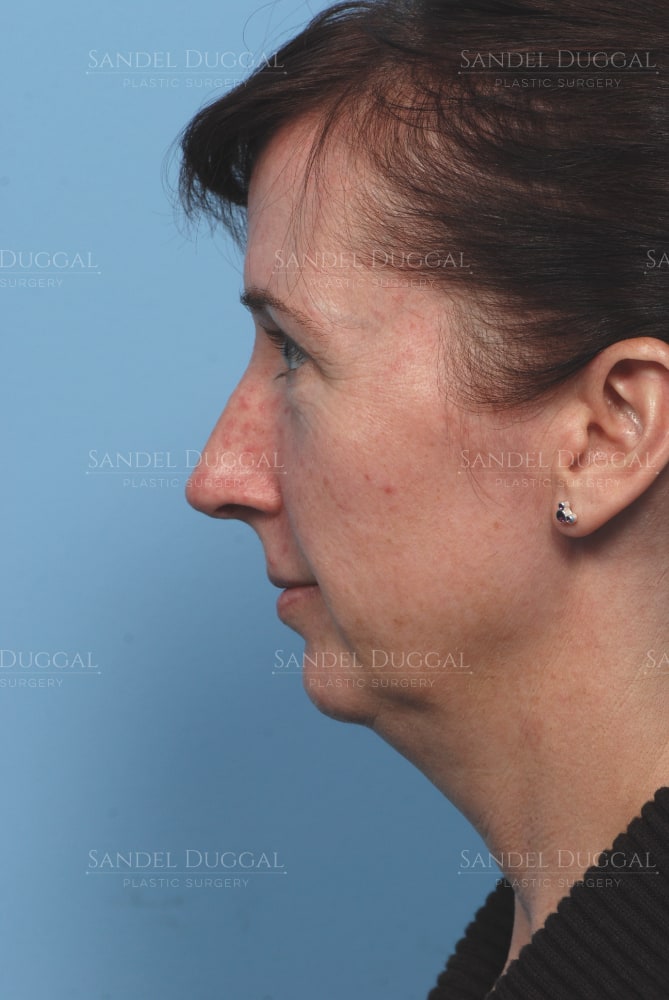 Before
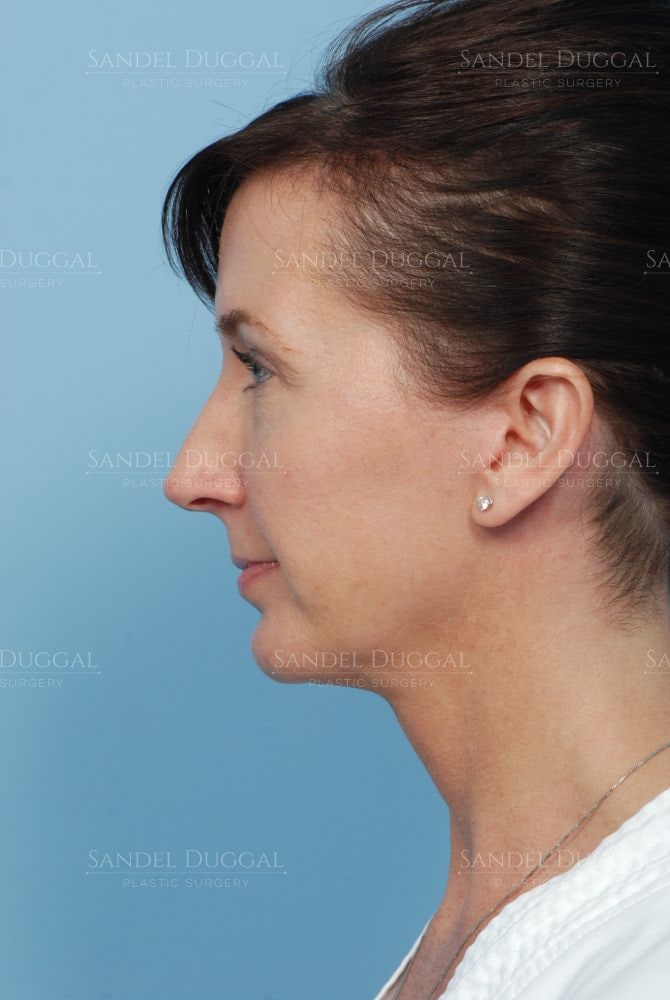 After
AfterFacelift with chin implant, pre-jowl implant, and upper eyelid surgery — an actual patient of Dr. Sandel.
 Before
 After
AfterFacelift — Case 813, oblique left view. An actual patient of Dr. Sandel.
“Facelift procedures have changed a lot over the past 20 years. We are now focusing on specific parts of the face, most commonly the lower face and neck, with procedures that are less invasive and require less downtime.”
Henry D. Sandel IV, MD, FACS
The process
From consultation to final result.
01
Consultation
An assessment of your facial anatomy, a discussion of your goals, an outline of the facelift procedures available, and a review of recovery and aftercare.
02
Your plan
Dr. Sandel tailors the procedure to your anatomy and rejuvenation needs, and our staff provides a detailed cost breakdown.
03
Surgery
Performed at our West Annapolis Surgery Center under light anesthesia, with local numbing medication so you feel nothing during surgery.
04
Recovery
Detailed post-operative instructions and scheduled follow-up appointments to monitor your healing progress.
Incisions and placement
Where the incisions are placed.
Facelift incisions are made so that they can be hidden as completely as possible. Dr. Sandel places none of them in front of the ear or in front of the hairline.
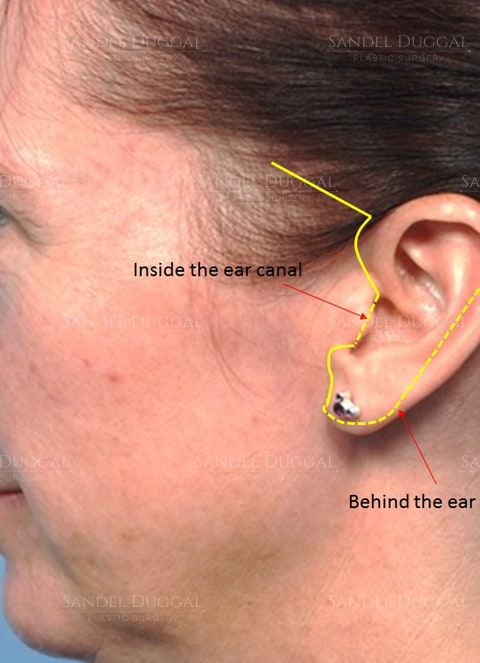
Around the ear
The incision hugs the earlobe in a natural skin crease, extends inside the front of the ear, and curves around into the hairline. In men it is left in front of the ear to avoid facial hair growth on the ear.
Behind the ear
Placed just above the ear crease to prevent scar bands, then gently extended into the hairline high enough not to be noticeable. Patients can style their hair any way they like afterward.
Beneath the chin
A small incision in the lower chin crease treats the neck, and is virtually invisible once healed. It is also where neck liposuction is performed if needed.
How they heal
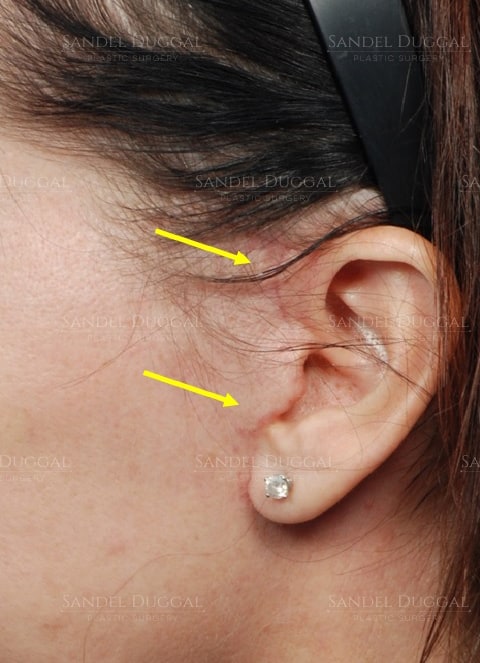
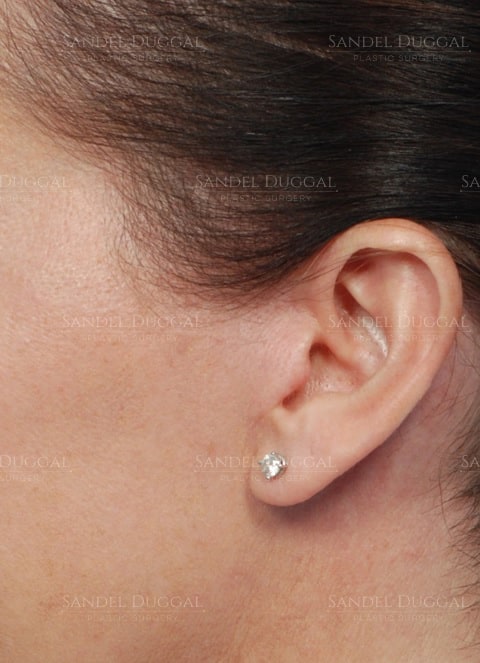
Incision lines are difficult to see within a few days of surgery, even with the sutures still in place. They continue to fade over the first several months. An actual patient of Dr. Sandel.
The technique
Lifting the muscle layer to support the skin.
Dr. Sandel uses a modified deep plane rhytidectomy technique, the modern evolution of the deep plane facelift, combined with a corset platysmaplasty where the neck calls for it. Together they give a long lasting lift without an unnatural or pulled appearance. A full deep plane lift is the right operation for a small number of patients and he performs it in those cases, but the modified deep plane is the more modern operation and his preferred technique for most patients.
Step one
Modified deep plane
The muscle layer beneath the skin is released and repositioned, so the lift is supported from below. The skin is simply re-draped over it in a very natural way, without pulling on the corners of the mouth.
Step two
Corset platysmaplasty: the neck lift
The treatment of the neck and the angle beneath the chin and jawline. This is the key to defining the chin-neck angle, removing the bands of skin, and supporting the facelift. Only a very small incision beneath the chin is required. Not every patient needs one — whether it forms part of your operation depends on your neck. This is the neck lift portion of the operation, and it is part of most full facelifts we perform.
Extent
Options, matched to your face.
What changes between them is how much your face needs, and how much recovery goes with it.
Modified deep plane facelift
The modern evolution of the deep plane facelift, and his preferred technique for most patients, for established laxity through the face and neck. The muscle layer is released and repositioned and the skin re-draped over it, with a corset platysmaplasty where the neck calls for one.
Deep plane facelift
The original operation. The full deep plane release is the right choice for a small number of patients, and Dr. Sandel performs it in those cases. For most patients its modern evolution, the modified deep plane, is the better answer.
Tuck-up facelift
For patients who have had a facelift before and have aged since. The skin and muscle are lifted again to address the change that has happened in the years between.
Mini-lift
For a more subtle result, and often for younger patients with less to correct. Less extensive than the full lift, and less downtime with it.
The sequence
What the operation involves, in plain terms.
The release is complete across the layers that are actually falling. It stops where further dissection stops rewarding the patient.
01
The neck, first
Through a small incision hidden in the crease beneath the chin, Dr. Sandel removes the excess fat with careful liposuction, deliberately sparing the jowls so the jawline stays smooth, then brings the front edges of the platysma muscle together in the midline. This is what defines the neck from the front and sharpens the angle beneath the chin.
02
Then the face
The incisions are hidden in the natural lines around the ear. The skin is lifted, then the SMAS layer is fully elevated across the cheek, the jawline and the upper neck, and that release is carried up over the cheekbone in the deep plane, freeing the attachments that hold the midface down. The lifted layer is anchored to two sturdy fixed points, the firm tissue in front of the ear and the bone behind it, so the lift is held by the deep layer and not by tension on the skin. A small drain stays in overnight to keep bruising down.
03
Where the dissection stops
What Dr. Sandel deliberately does not do is carry the dissection beneath the midface periosteum, or take the skin out to the corner of the mouth. In his experience those steps add days of swelling and nerve exposure without a result patients can see. This is not a lighter operation. It is a complete one that stops where the anatomy stops rewarding you for going further.
Technique
What the deep plane release looks like.
Two short clips from Dr. Sandel's own operating room, filmed without sound.
Surgical footage
This clip was filmed in the operating room.
It shows the technique being performed and some viewers will find it graphic. There is no sound.
I understand, show the clip
Elevating the SMAS
The SMAS layer is elevated across the cheek and jawline, and the release carried up over the cheekbone in the deep plane.
Surgical footage
This clip was filmed in the operating room.
It shows the technique being performed and some viewers will find it graphic. There is no sound.
I understand, show the clip
Elevating the skin flap
The skin is lifted off the layer beneath it, without tension being placed on it.
Contains surgical footage. No audio.
Anesthesia
Why most patients are asleep.
The choice affects the result, not just how the day feels.
Why not local for a deep plane lift
It is hard to get the deep layer fully numb, and it takes a great deal of lidocaine with epinephrine to do it. The injection alone is uncomfortable at that extent.
Patients also carry anxiety, sometimes without knowing it, and that raises blood pressure and heart rate. Higher pressure means more bleeding during the operation, and more swelling and bruising afterwards.
If I am worried something may cause pain, my attention is divided. Surgeons hold back when they think a patient may feel something, and that shows in the result.
What being asleep changes
An anesthesiologist keeps you free of pain and keeps blood pressure and heart rate low, at a depth light enough that you wake easily and quickly. I stop thinking about comfort and focus on the lift.
A general anesthetic here stays light, and I inject the local once you are asleep. That keeps medication and narcotics to a minimum, because you are not feeling pain in the first place.
Patients wake with much less of a hangover, rested rather than anxious, with less swelling and bruising.
The anesthesiologist’s fee is already part of the figure we quote, not billed on top.
Recovery
What the first two weeks actually look like.
Recovery in Dr. Sandel's practice follows a predictable arc. Restraint in the operating room is what makes it short.
Recovery varies by individual. Dr. Sandel will give you a realistic timeline for your own case at your consultation.
Facelift recovery for Baltimore patients
Many of our facelift patients come from Baltimore and the surrounding area. Annapolis is about 40 minutes away, close enough to recover at home and still make the two visits that matter most: the morning after surgery, when the wrap and drain come off, and day 7, when the sutures come out. Someone will need to drive you home after surgery and to the morning-after visit, unless you stay in our overnight recovery suite or at a local hotel. If you are travelling from farther away, our out-of-town patients page explains how we plan your stay.
The morning after
The face wrap and the drain come off, and an ice wrap takes their place for a day or two. After that no dressings are needed, apart from one at night as a reminder while you sleep.
Pain
Minimal. Tylenol is what most patients need.
The first week
You will feel tight and swollen, and for most patients that is all it is. The job that week is to rest and keep your heart rate and blood pressure down, even if you feel fine, because that is what keeps swelling and bruising down.
Day 7
Sutures come out. Flying is fine from about this point.
Around day 10
Most patients are presentable in public.
Two weeks
Full activity, coming back gradually rather than all at once.
Patient story
A patient's life changing experience in her own words.
BeforeAfterThe same patient, before and after.
The patient shown before and after at the top of this page, speaking about her surgery and her care at the center.
“I would recommend Dr. Duggal and Dr. Sandel for their professionalism, their ability to take you as an individual.”
The names you will see
A name is not an operation.
New labels arrive constantly. Most of them describe work Dr. Sandel already does under its anatomical name. One procedure he does not perform at all. Neck lift belongs in the first group: what patients call a neck lift is the corset platysmaplasty, and it is part of most full facelifts he performs.
More of his positions on facelift trends are in Trending Now.
Ponytail lifts
A marketing term rather than a technique. Ask three surgeons what a ponytail lift involves and you can get three answers: for some it is the upper third of the face, the brows or the temples; for others the midface; for others the lower face and neck.
That range is the problem with the label. It tells you nothing about which layer is being lifted, how far the release goes, or where the incisions sit, and those are the things that decide your result and your recovery. For the most part good facial plastic surgeons address these areas using similar techniques. What differs is the name, and interesting names exist to help a practice stand apart.
Dr. Sandel’s techniques for the upper, middle and lower face and neck are similar to one another by design. They are structural: the supportive components of the face are lifted rather than the skin pulled, which is what makes a result last and what keeps it from looking pulled or overdone. The goal in surgery is to put the tissues back where they came from as the face descends with age. That is what makes it look natural rather than altered.
So the useful questions are not about the name. Which layer, how far, where do the incisions go, and what does recovery actually look like. His answers are in his position on the deep plane label and in the technique described above.
Thread lifts
Dr. Sandel does not perform them. They are marketed as minimally invasive facelifts: no skin lifted or removed, and only a small incision to insert a thread.
The threads are barbed permanent sutures. The barbs face one direction, so a thread advances when pulled one way and grips when pulled the other. Each is introduced through a small incision and pushed into position with a needle, then drawn up to lift the tissue with it and secured to the fascia beneath the skin. No skin is removed, and the lifted tissue is never freed from the underlying connective tissue holding it down — the step a facelift depends on.
His objection is straightforward. If the threads lifted the skin far enough to make a visible difference, the excess skin would have nowhere to go, because nothing has been removed. It would gather — the pulled appearance thread lifts are marketed as helping you avoid. Which leaves the procedure caught between two outcomes: lift enough to see and it looks operated, lift gently enough to look natural and there is little to see. They can also produce a number of problems that may be difficult to correct, which is a great deal to accept from a procedure sold as minor.
For patients who are not ready for surgery, the non-surgical treatments the practice does offer — dermal fillers and tox treatments among them — are discussed honestly, including what they can and cannot achieve.
Cost
Facelift cost in Annapolis
From about $9,400. One figure, quoted in writing before you decide.
Every figure covers
You will receive a written, itemized quote at your consultation. Financing is available.
Published facelift fees at practices in the Baltimore and Washington area reach $15,000 to $20,000, and more for a deep plane facelift.
Some of those figures cover the surgeon only, with the surgery center and anesthesia billed on top, so the gap is often wider than it looks. Published fees reviewed September 2026.
Why ours is lower
Time
Facial surgery is all I do, and I operate with the same nurses, scrub tech and anesthesia team every day. A mini lift takes us about an hour and a half. A full modified deep plane facelift takes about two and a half hours, and that includes the corset platysmaplasty rather than adding it on top.
Facility and anesthesia fees are billed by time, so a shorter operation costs less and you spend less time under anesthesia.
Faster does not mean less done. It is the same complete operation either way, with the full release of the deep layer and the corset platysmaplasty where the neck calls for it. We are quicker at it because we do it every week with the same people.
Our own surgery center
West Annapolis Surgery Center is ours, in the same building as our office, and it is fully accredited.
Because we own it, we set the facility fee ourselves, and there is no hospital or outside surgery center charge passed along to you.
Fees current as of September 2026.
Questions patients ask.
Talk it through with Dr. Sandel.
A consultation includes a full facial assessment, a review of surgical and non-surgical options, and an honest answer about what a facelift and neck lift would and would not change. Dr. Sandel has performed more than 10,000 facial rejuvenation surgical procedures, including more than 5,000 facelift procedures for the neck, lower face and jawline, midface and forehead.
Dr. Sandel on this
Do you need a deep plane facelift?
The deep plane facelift is a real and valuable operation, and the modified deep plane Dr. Sandel performs is its modern evolution. The label is being used to sell extent, and extent is not the same as quality.