

Rhinoplasty with Dr. Henry Sandel
Rhinoplasty
Rhinoplasty is one of the most challenging cosmetic surgeries to master. Dr. Sandel is double board-certified in facial plastic and reconstructive surgery and in otolaryngology — a recognized expert and specialist in the procedure.
At a glance
Surgeon
Dr. Henry Sandel
Procedure time
1½–2 hours
Anesthesia
General (light)
Setting
West Annapolis Surgery Center
Splint worn
About a week
Back to work
About a week
Exercise
About 2 weeks
Fully healed
3–12 months
Form and function, in one procedure
Sometimes referred to as a nose job or nose reshaping, cosmetic rhinoplasty can reduce the size of a nose that is too large for the face, straighten a crooked nose, or change the size and shape of the bridge or tip — making the nose look smaller, softer, more symmetrical, and in better proportion with your face.
Rhinoplasty can also resolve breathing problems caused by a deviated septum or a collapsed nasal valve. A skilled surgeon can correct these issues at the same time as cosmetic nose surgery, for an overall improvement to both breathing function and facial appearance. Insurance companies sometimes cover surgeries performed to correct breathing problems.
You might consider rhinoplasty if your nose
Is too large, too small, too wide or too narrow in relation to your other facial features
Has a noticeable hump
Is depressed at the bridge, where it meets the eyebrows
Has a nasal tip that is bulbous, upturned, drooping or hooked
Is crooked or asymmetrical
Causes you breathing problems
It is essential to note how the appearance of your nose relates to your other facial features. A small chin, for example, can make a perfectly proportional nose appear too large. In your consultation, Dr. Sandel will evaluate the combination of your facial features and recommend an approach to bring them into better harmony, using photographic simulation from multiple angles to show you what your face will look like with the changes he recommends.
VECTRA 3D imaging
See your new nose before surgery.
At your consultation, Dr. Sandel takes a three-dimensional photograph of your face and, using Vectra simulation software, applies the proposed changes to your own image — so you can view the plan from every angle, compare options side by side, and refine it together before anything is scheduled. Precise measurements from your own anatomy then guide the operation itself.
Learn about Vectra 3D imaging →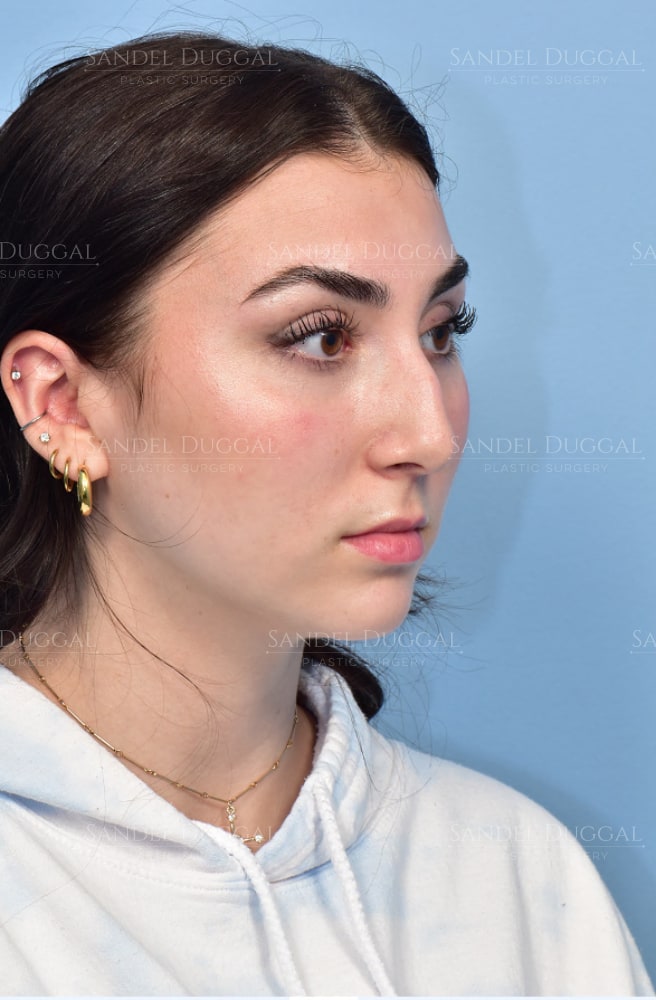 Before
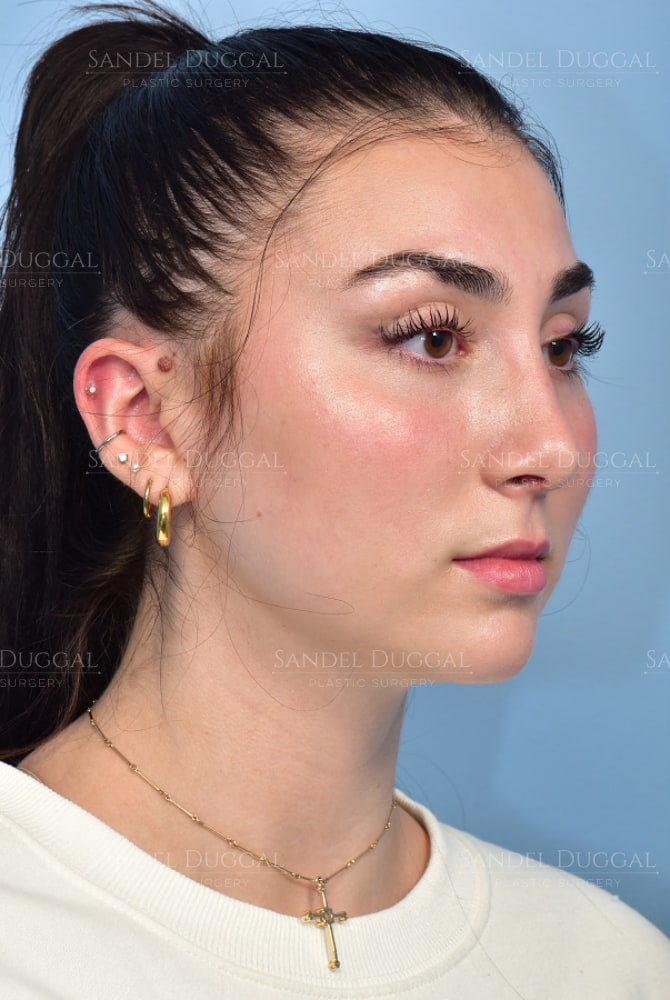 After
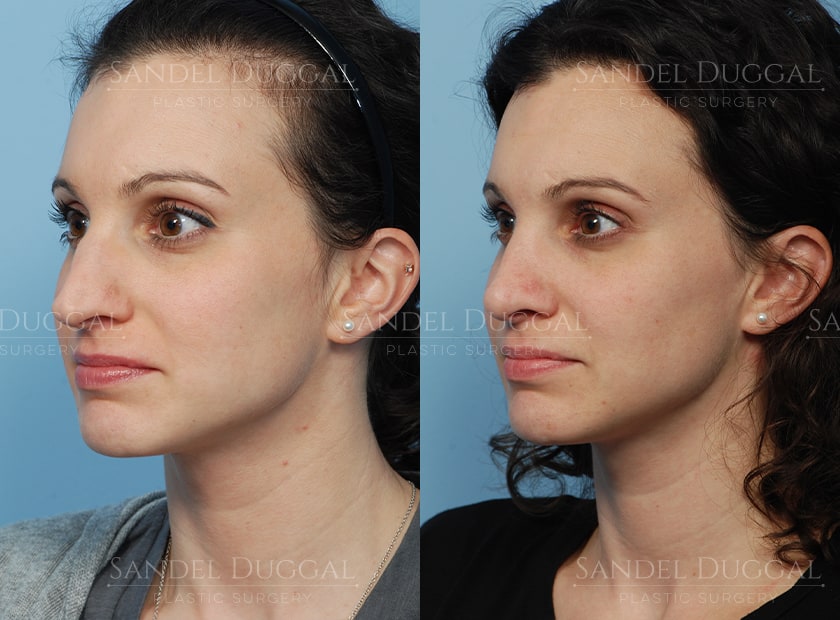
AfterRhinoplasty before and after, three-quarter view — an actual patient of Dr. Sandel.
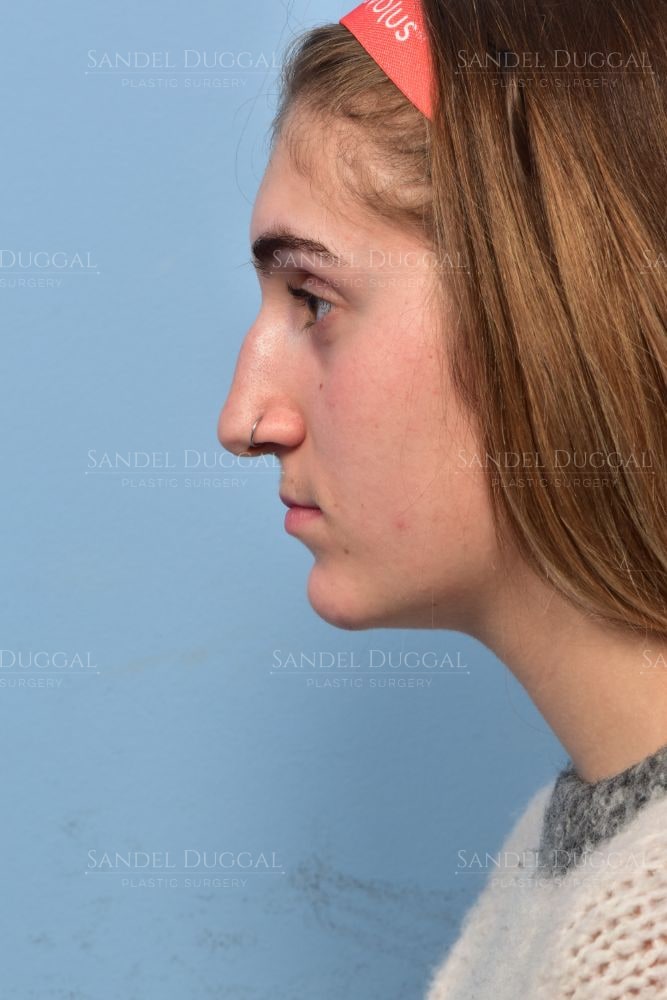 Before
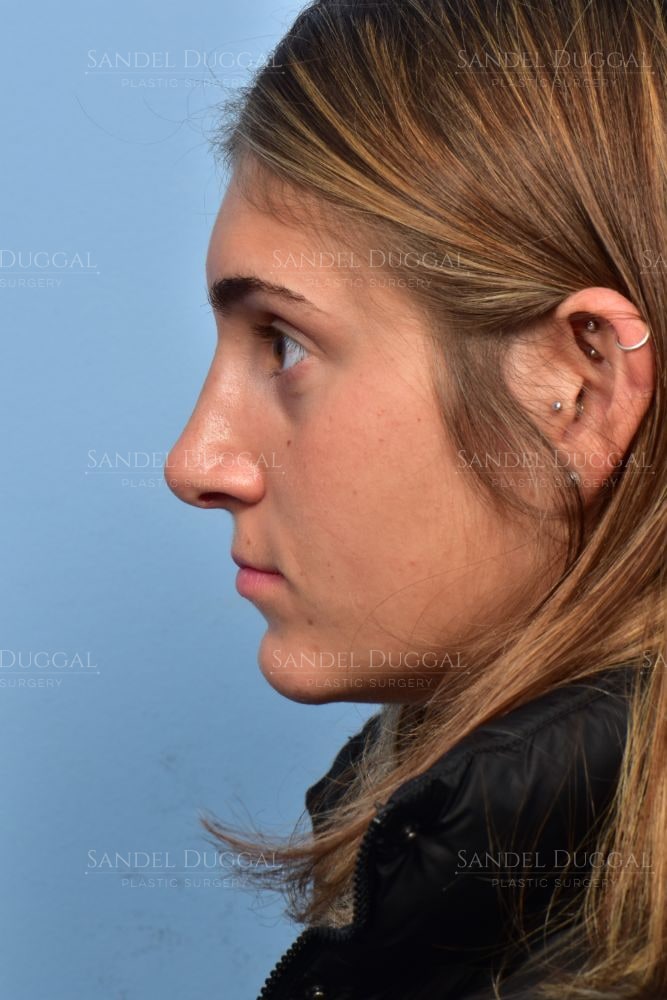 After
AfterRhinoplasty before and after, profile view — an actual patient of Dr. Sandel.
An additional patient case.
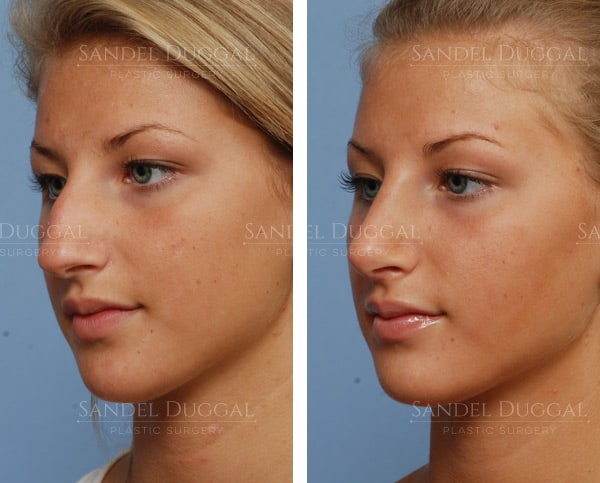
Rhinoplasty before and after — an actual patient of Dr. Sandel.
Surgical approaches
Open or closed, tailored to your anatomy.
Open or external rhinoplasty
Offers enhanced precision for complex structural changes or significant refinement. A small incision across the skin between the nostrils provides better visibility and access to nasal structures.
Endonasal or closed rhinoplasty
Uses internal incisions only, enabling simpler adjustments with minimal scarring. Dr. Sandel will tailor his approach to your anatomy and goals.
On surgery day
Rhinoplasty is typically an outpatient procedure performed at our surgical center under general (light) anesthesia, monitored by a board-certified anesthesiologist. Dr. Sandel makes an incision, either inside the nose or between the nostrils, to expose the bone and cartilage support system, then reshapes the nose by removing, adding to, or rearranging the structure.
Having completed the reshaping, he re-drapes the tissues over the new framework and closes the incisions, and may use a splint to support the newly shaped nose. You go home the same day once you have awoken from anesthesia, with someone to drive you and stay with you for the first 24 hours.
Recovery
For about a week you will wear a splint to hold your nose in its new shape, and can expect some minor swelling and bruising. Most patients return to work and light activities after about a week, once the splint is removed, though returning sooner is possible. Exercise resumes at about two weeks; contact sports at six to eight weeks.
Swelling decreases slowly and may come and go. By two weeks it is typically not noticeable to others. Your nose should be fully healed in three to twelve months.
Rhinoplasty for Baltimore patients
Many of our rhinoplasty patients come from Baltimore and the surrounding area. Annapolis is about 40 minutes away, so you can recover at home and come back after about a week to have the splint removed. Someone will need to drive you home after surgery. If you are travelling from farther away, our out-of-town patients page explains how we plan your stay.
Recovery
The nose heals in stages, and the last one is long.
The first fortnight is straightforward and predictable. The tip is the part that takes its time, and being told that honestly beforehand makes the wait easier.
This is the guidance we give every patient, alongside the general instructions that follow any surgery. Your own sheet and Dr. Sandel’s instructions govern your case. Call the office on (410) 266-7120 with any question about your healing.
The first 48 hours
Cold compresses to the cheeks and under the eyes, never directly on the nose, and your head elevated to about thirty degrees. Expect drainage for roughly four hours; change the drip pad under your nose as needed and do not tape it tight.
The morning after
The cotton in your nose comes out.
The first week
Do not blow your nose, and if you have to sneeze, do it with your mouth wide open. Saline spray as directed keeps the passages moist. Keep glasses off the bridge until we clear it. Bruising under the eyes becomes more noticeable before it fades.
Congestion
Stuffiness for several weeks. It is a normal part of healing and not a sign the airway has failed to improve.
Weeks to months
Swelling settles, with numbness of the tip easing gradually.
Up to a year
The final shape of the tip. Most of the change is visible early, but the last refinement is slow and worth waiting for.
When to call
Severe pain that the medication does not relieve, or a fever.
Cost
Rhinoplasty cost in Annapolis
One figure, quoted in writing before you decide.
That figure covers
You will receive a written, itemized quote at your consultation. Financing is available.
A chin implant is the common addition, because the chin and the nose set the profile together. Added to a rhinoplasty it costs less than having it on its own day, since most of the operating time is already accounted for.
We own West Annapolis Surgery Center and operate with the same team every day, so there is no hospital or outside facility charge passed along to you.
Insurance and breathing problems
Fees current as of September 2026.
Questions patients ask.
Trust your nose to a specialist.
Dr. Sandel has performed more than 3,500 rhinoplasty procedures, including revision rhinoplasty, nasal reconstruction and functional nasal surgery, and has written book chapters and journal articles on the subject. He receives referrals from fellow plastic surgeons and ENT surgeons whose patients require specialized care.