Annapolis, Maryland|(410) 266-7120|Contact us|About|Gallery|Patient Resources
Home›Face›Facial Reconstruction

Facial reconstruction with Dr. Henry Sandel

Facial Reconstruction

We understand how essential your face is to your identity. Facial reconstruction corrects deformities or disfigurement caused by birth defects, disease, or injury — addressing appearance and function alike.

At a glance

SurgeonDr. Henry Sandel
Board certified inFacial plastic surgery and otolaryngology
SettingWest Annapolis Surgery Center
AnesthesiaGeneral, or local with sedation
PlanningX-rays, photographs, imaging
InsuranceOut-of-network; may reimburse

Surgeon

Dr. Henry Sandel

Board certified in

Facial plastic surgery and otolaryngology

Setting

West Annapolis Surgery Center

Anesthesia

General, or local with sedation

Planning

X-rays, photographs, imaging

Insurance

Out-of-network; may reimburse

Six kinds of reconstruction

A broad term for a range of procedures.

We use the most advanced techniques in reconstructive surgery, combining technical and medical skills with aesthetic expertise, and work closely with you to restore your facial appearance and function so you can feel like yourself again.

Dr. Sandel has dual board certification in facial plastic and reconstructive surgery and in otolaryngology — critical for reconstruction involving the nose, mouth, throat, and upper airway.

Smaller repairs are part of the same work. Moles, cysts and other growths on the face are removed in the office under local anaesthesia, with incisions planned to heal quietly. See skin lesion and cyst removal.

After injury from a car crash, physical violence, or other trauma, this may involve realigning bone fragments, minimizing scar tissue, and restoring function to facial nerves, tear ducts, or salivary glands. It might require surgery to restore form and function to muscles, bones, skin, nerves, cartilage, and connective tissue across the face and neck. People disfigured in an accident often need reconstruction after initial life-saving measures.

Restores as much facial mobility as possible by correcting damage to nerves and muscles. It may also include facial plastic surgery to achieve symmetry in facial features.

Makes scar tissue less visible when wounds, burns, surgery, acne, or other causes leave the skin damaged.

Nose reshaping may be necessary when an injury or illness leaves the nose disfigured. Rhinoplasty can restore a symmetrical appearance to the nose and simultaneously address breathing problems.

Ear reconstruction surgery may be necessary when one or both ears are malformed from birth or become disfigured after an injury or illness.

May involve skin grafts, tissue rearrangement, or more complex transfer of skin, bone, or cartilage to restore normal facial appearance and function.

Disfigurement we treat

—

Traumatic injury, such as a car or motorcycle accident

—

Physical assault

—

Sports injury

—

Infection or disease, such as cancer

—

Facial paralysis

Functional impairments

—

Breathing problems from airway obstruction

—

Difficulty chewing or swallowing

—

Double vision, difficulty blinking, tear duct impairment

—

Salivary gland impairment

—

Misaligned teeth

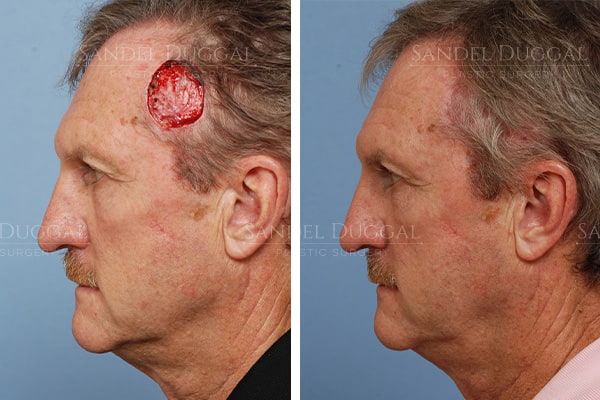
Forehead reconstruction before and after, actual patient

How it is performed

Customized to the injury and the patient.

Dr. Sandel performs a thorough analysis of your face using X-rays, photographs, or other imaging, then suggests a personalized treatment plan. In some cases a combination of procedures is necessary, staged across more than one surgery over time.

Post-traumatic reconstruction takes place in our West Annapolis Surgery Center under general anesthesia, typically within the first one to two weeks after the injury. Dr. Sandel repairs facial fractures, most often cheekbone fractures from sports injuries and broken noses, and implants and stabilizing plates or screws may be used. Fractures of the lower jaw are treated by oral surgeons, usually immediately.

Other types of reconstruction may only require local anesthesia and mild sedation. To make scars less visible or restore skin damaged by burns or the removal of cancer, options include steroid treatment, skin grafts, or Z-plasty surgery.

Recovery

Because the range of procedures is so broad, there is no single description of recovery. Simple treatments have faster recovery times, while more extensive reconstruction may require a lengthy recovery period. For most procedures you will need to wear a gauze bandage, and over-the-counter medication can manage discomfort.

Dr. Sandel provides detailed instructions for your care, including directions for preventing infection, a timeline for rest and recuperation, and a schedule of follow-up appointments.

Insurance

Insurance rarely covers elective plastic surgery performed merely to improve appearance, but typically does cover medically necessary treatment. Because facial reconstruction can correct functional problems and problems present at birth or resulting from illness or accident, your insurance may cover all or some of the cost. Dr. Sandel can advise you with more specifics at consultation. Dr. Sandel is an out-of-network provider. If your insurance company offers you out-of-network benefits, you could be reimbursed for the medically necessary portion of the procedure. We will give you the medical notes, procedure codes, and diagnostic codes to help with this process.

Questions patients ask.

Facial reconstruction at Sandel Duggal Plastic Surgery is performed by Dr. Henry Sandel. He has dual board certification in facial plastic and reconstructive surgery and in otolaryngology, which is critical for reconstruction involving the nose, mouth, throat and upper airway. He analyzes your face using X-rays, photographs or other imaging and builds a personalized plan that addresses both appearance and function.

Facial reconstruction corrects deformity or disfigurement caused by birth defects, disease or injury, restoring function as well as appearance. Common causes include car and motorcycle accidents, physical assault, sports injuries, cancer and facial paralysis. Functional problems it can address include breathing problems from airway obstruction, difficulty chewing or swallowing, double vision, difficulty blinking, tear duct and salivary gland impairment, and misaligned teeth.

Insurance may cover all or part of the cost of facial reconstruction, because it typically covers medically necessary treatment: correcting functional problems, problems present at birth, or damage from illness or accident. It rarely covers surgery performed only to improve appearance. Dr. Sandel is an out-of-network provider; if your insurance offers out-of-network benefits, you could be reimbursed for the medically necessary portion, and we provide the medical notes, procedure codes and diagnostic codes to help.

Post-traumatic facial reconstruction is done under general anesthesia, while other types of reconstruction may need only local anesthesia and mild sedation. Reconstruction after an injury takes place at our West Annapolis Surgery Center under general anesthesia. Smaller repairs, such as skin grafts, Z-plasty or steroid treatment to make scars less visible after burns or cancer removal, may only require local anesthesia and mild sedation.

Recovery after facial reconstruction depends on the procedure: simple treatments heal quickly, while extensive reconstruction may require a lengthy recovery period. Because the range runs from a small skin repair to rebuilding bone and soft tissue, there is no single timeline. For most procedures you wear a gauze bandage, and over-the-counter medication manages discomfort. Dr. Sandel gives detailed instructions on preventing infection, a timeline for rest and recuperation, and a schedule of follow-up appointments.

Many facial reconstructions are completed in a single procedure, but in some cases a combination of procedures is necessary, staged across more than one surgery over time. Staging lets each part of the repair heal before the next is done. Dr. Sandel sets out the expected sequence when he presents your personalized treatment plan, so you know the full course from the start.

Yes. Dr. Sandel repairs facial fractures, most often cheekbone fractures from sports injuries and broken noses (nasal bone fractures), and implants and stabilizing plates or screws may be used. Fractures of the lower jaw (mandible) are different: they are treated by oral surgeons and are usually repaired immediately.

Reconstruction after a facial injury is typically done within the first one to two weeks, and most often it is for bone trauma such as facial and nasal fractures. That window lets the initial swelling settle enough to assess and repair the injury accurately. If you have had a facial injury, see Dr. Sandel early so the repair can be planned within that time.

A facial reconstruction consultation begins with a thorough analysis of your face, using X-rays, photographs or other imaging, and a conversation about what you want restored in both appearance and function. Dr. Sandel then suggests a personalized treatment plan, including whether a combination of procedures is needed and how it might be staged. He can also advise you on what insurance may cover for your case.

However minor or severe.

No matter the injury or disfigurement, facial reconstruction can help. Our priority is to provide sophisticated treatment in close consultation with our patients, with personal attention throughout the process.

Request a consultation(410) 266-7120

Reviewed by Henry Sandel, MD · Updated November 2026