
Tummy tuck with Dr. Claire Duggal
Tummy Tuck
A tummy tuck restores a flatter, tighter abdomen by removing excess fat and skin and repairing any separation between the stomach muscles. Dr. Duggal’s signature technique improves your outcome and speeds your recovery.
At a glance
Surgeon
Dr. Claire Duggal
Procedure time
2–3 hours
Anesthesia
General
Setting
West Annapolis Surgery Center
Home same day
Usually, overnight optional
Office work
About 2 weeks
Physical work
About 4 weeks
Exercise
About 6 weeks
Final results
6–12 months
When a tummy tuck is the right answer
Pregnancy, significant weight changes, aging, and genetics can all affect the appearance and strength of the abdomen. For some patients, the skin and abdominal wall may stretch beyond the point where they can fully return to their previous shape on their own.
A tummy tuck may be appropriate when excess skin and weakened or separated abdominal muscles create a loose, protruding, or less defined abdomen that does not improve with healthy lifestyle changes alone. By removing excess skin and addressing abdominal wall laxity when needed, abdominoplasty can create a smoother, firmer, and more contoured midsection.
Why patients consider it
Am I a good candidate?
The best candidates are in good overall health, at or near a stable weight, and bothered by excess abdominal skin, abdominal wall laxity, or changes that have not improved with diet and exercise alone. The procedure is highly individualized — during your consultation, Dr. Duggal will evaluate your anatomy, discuss your goals, and determine which approach will best achieve your desired result.
If you are planning significant weight loss or future pregnancy, Dr. Duggal may recommend waiting until your weight and family planning are stable. A tummy tuck is a body-contouring procedure, not a weight-loss procedure — results can be long-lasting when a stable weight and healthy lifestyle are maintained.
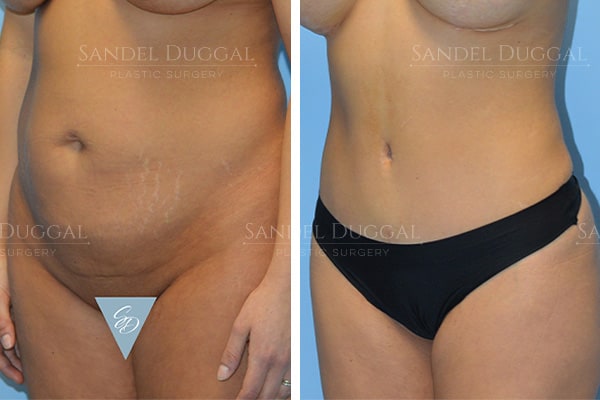
Tummy tuck before and after — an actual patient of Dr. Duggal.
“An abdominoplasty is a wonderful way to restore a woman’s stomach after pregnancy and childbirth. Not only can we remove the excess skin and often the majority of any stretchmarks she has, but we can also tighten her abdominal muscles and restore a flat, strong abdomen.”
Dr. Claire Duggal
Often combined with
What happens during the procedure
A tummy tuck is performed under general anesthesia. Dr. Duggal makes a low abdominal incision, removes excess skin, and, when needed, repairs separation or laxity of the abdominal muscles. She then re-drapes the skin and carefully repositions the belly button for a natural appearance.
Dr. Duggal does not routinely perform liposuction of the abdomen during a tummy tuck. When additional contouring is appropriate, she may combine the procedure with liposuction of the waist and flanks, upper back, or bra roll. Exparel®, a long-acting local anesthetic, is used to help manage postoperative discomfort, and the incision is closed with dissolvable sutures.
Her progressive-tension technique is designed to minimize the space where fluid can collect. A drain is typically placed to help manage fluid during the early stages of healing. The procedure typically takes two to three hours. Dr. Duggal places the incision as low as possible to keep it concealed beneath underwear or a bikini bottom; scar appearance continues to improve as it matures, and treatments such as laser or microneedling may be considered when appropriate.
Variations on the procedure
A full tummy tuck addresses excess abdominal skin and may include repair of separated or weakened abdominal muscles (diastasis recti), with an incision across the lower abdomen designed to create a flatter, firmer contour.
A mini tummy tuck focuses on excess skin below the belly button — similar in concept to a C-section scar revision — with a shorter incision and no muscle repair, best suited to concerns limited to the lower abdomen.
An extended tummy tuck uses a longer incision extending toward the hips, addressing excess skin along the lower abdomen and sides.
Additional body contouring may be performed when appropriate — liposuction of the waist and flanks, upper back, or bra roll for a more balanced, defined silhouette.
What to expect in recovery
Most patients go home the same day, but some prefer to stay overnight in our surgical suite, especially when combining procedures. You will need someone to drive you home, and it is best to have someone stay with you for the first 24 hours.
The first three to five days are typically the most uncomfortable. Medication can help manage discomfort, and light walking is encouraged early in recovery. Most patients gradually return to normal activity as they heal, with most swelling resolving around six weeks and final results continuing to develop over the following months.
Many patients can return to office-based work in approximately two weeks, while more physically demanding work may require closer to four. For the first two to three weeks, plan to have help with lifting, childcare, household tasks, and other strenuous activities. Most patients can gradually return to exercise around six weeks, depending on their healing and Dr. Duggal’s recommendations.
Questions patients ask.
Schedule your consultation.
Dr. Duggal will review your goals, mark and demonstrate your incision pattern, and explain the operation and recovery in full before you decide anything.