
Annapolis, Maryland|(410) 266-7120|Contact us|About|Gallery|Patient Resources
Home›Face›Mohs Surgery

Mohs reconstruction with Dr. Henry Sandel

Mohs Surgery & Reconstruction

We are proud to be a referral center for either simple or complex skin cancer reconstruction, working with local dermatologists so you get the most optimal outcome — from the cancer resection through the repair.

Diagnosed with a skin cancer? Come to us first. We guide your care from there, coordinate with the Mohs dermatologist who removes the cancer, and repair the defect here the same day.

At a glance

SurgeonDr. Henry Sandel
RoleReconstruction after excision
Referred byLocal dermatologists
InsuranceOften covered as medically necessary

Surgeon

Dr. Henry Sandel

Role

Reconstruction after excision

Referred by

Local dermatologists

Insurance

Often covered as medically necessary

What Mohs surgery is

Mohs surgery removes skin cancer by serial excisions. The smallest area of visible cancer is taken first, and the skin margins are tested while you wait. If an area is still positive for cancer, a little more skin is removed. This process repeats until all the cancer is gone, leaving as much normal skin surrounding it intact.

That matters because only the cancer is removed. No longer do we have to make large incisions and wait a week for testing to confirm the cancer is gone.

How the two halves fit together

Mohs surgery is performed by specialized dermatologists who are also trained in pathology, with a lab set up in their office to process specimens on site. Many patients diagnosed with skin cancer on the face, nose, eyelids, lips, or ears are referred to those dermatologists by their primary care physician.

If the cancer defect is in a difficult place to close, or if you are concerned about scarring, that is where we come in. Dr. Sandel may coordinate your treatment with a Mohs dermatologist, who performs the excision, and you come back to our office the same day to have the wound repaired.

Not every growth needs Mohs. Moles, cysts and other benign lesions are removed in our office, with the same care given to the closure. See skin lesion and cyst removal.

Why we ask to see you first

Seeing you before the excision is what lets the two halves work as one. We review your repair options, anticipate the defect the excision will leave, and agree the plan with your Mohs dermatologist in advance.

The reconstruction is then planned around the defect rather than improvised after it, and your repair is scheduled here for the same day, so the wound is closed without delay. That is what produces the best outcome with minimal scarring.
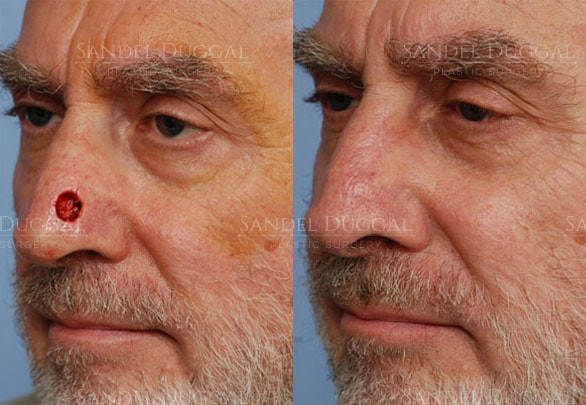
Mohs reconstruction before and after, actual patient

Mohs reconstruction before and after — an actual patient.

Before
After

Cheek reconstruction following Mohs excision — the defect at presentation, and the healed repair.

Dr. Sandel’s approach

“Let us be your go-to place for skin cancers on the face and body. If you have been diagnosed with skin cancer come in for a consult. We can manage your treatment from start to finish and coordinate with a Mohs dermatologist if they are needed.”

Common types of skin cancer

Melanoma

Basal cell carcinoma

Squamous cell carcinoma

Skin cancer is not easy to diagnose. It usually requires a trained specialist to examine the area and perform a biopsy.

Related procedures

Types of skin biopsies

Three ways a lesion is sampled.

Shave biopsy

Uses a flat edge to remove a small section of the top layers of skin. Raised, nodular, or flaking lesions are amenable to a shave biopsy. Because there is no incision, there is almost no noticeable scar. Most commonly, shave biopsies are sufficient.

Punch biopsy

A small instrument removes a core sample of the area in question. This is a very reliable choice for certain lesions because the entire thickness of the skin can be examined by a pathologist. Punch biopsies are so small they only require one or two sutures, leaving a small and mostly imperceptible scar.

Excisional biopsy

The removal of the entire lesion in question. This is performed in cases where closure is easily achieved and the patient wants the lesion removed anyway, whether cancer is diagnosed or not.

Insurance

Medically necessary care is often covered.

Reconstruction after Mohs excision of a skin cancer is medically necessary care, not elective surgery, and insurance typically covers it.

Dr. Sandel is an out-of-network provider. If your insurance company offers you out-of-network benefits, you could be reimbursed for the medically necessary portion of your care. We will give you the medical notes, procedure codes, and diagnostic codes to help with this process.

Questions patients ask.

Mohs surgery is a precise way of removing skin cancer, performed by specialized dermatologists who are also trained in pathology. The cancer is removed in thin layers, and each layer is examined under a microscope in an on-site lab until no cancer remains, which spares as much healthy skin as possible. At Sandel Duggal Plastic Surgery, we coordinate with your Mohs dermatologist and Dr. Sandel repairs the wound here the same day.

At Sandel Duggal Plastic Surgery, the wound left by Mohs surgery is repaired by Dr. Henry Sandel, a facial plastic and reconstructive surgeon. The Mohs dermatologist removes the cancer and tests the margins; Dr. Sandel then closes or reconstructs the defect. We are a referral center for simple and complex skin cancer reconstruction, working with local dermatologists, and patients are often referred to us when the defect is in a difficult place to close or when scarring is a concern.

Yes. When we coordinate your care, the Mohs dermatologist removes the cancer and you come back to our office the same day to have the wound repaired. Because Dr. Sandel sees you before the excision, the repair is planned around the expected defect and scheduled in advance, so the wound is closed without delay rather than left open while a plan is made.

Mohs reconstruction is usually done in West Annapolis Surgery Center, our accredited surgery center in the same building as the office. Depending on where the defect is and how large it is, the repair is done under local anesthesia or general anesthesia.

Seeing a facial plastic surgeon before Mohs surgery is worthwhile when the skin cancer is on the face, nose, eyelids, lips or ears. At that visit Dr. Sandel reviews your repair options, anticipates the defect the excision is likely to leave, and agrees the plan with your Mohs dermatologist in advance. If you have just been diagnosed with skin cancer, you can come to us first: we guide your care from there and coordinate with a Mohs dermatologist.

Yes, any repair after Mohs surgery leaves a scar, but a well-planned reconstruction is designed to make it as inconspicuous as possible. Dr. Sandel plans the repair around the defect before the excision, rather than improvising it afterward, which is what produces the best outcome with minimal scarring. Scars keep softening and fading for a year or more. If a healed scar still bothers you, scar revision can improve how it sits and blends.

Reconstruction after Mohs excision of a skin cancer is medically necessary care, not elective surgery, and insurance typically covers it. Dr. Sandel is an out-of-network provider. If your insurance company offers out-of-network benefits, you could be reimbursed for the medically necessary portion of your care, and we will give you the medical notes, procedure codes and diagnostic codes to help with that process.

Mohs surgery is used most often for basal cell carcinoma and squamous cell carcinoma, especially on the face, nose, eyelids, lips and ears, where saving healthy skin matters most. It is also used for some early melanomas and less common skin cancers. Your dermatologist decides whether Mohs is the right way to remove a particular cancer; Dr. Sandel’s role is the repair that follows, coordinated in advance with the Mohs dermatologist.

Mohs surgery removes skin cancer in stages and tests the margins while you wait, so only the cancer is removed and as much normal skin as possible is left intact. If an area is still positive for cancer, a little more skin is removed there, and the process repeats until all the cancer is gone. A standard excision takes a wider margin up front and sends it to a lab, which can mean waiting about a week to confirm the cancer is gone.

Yes. Mohs surgery is performed after a biopsy has confirmed a skin cancer, because skin cancer is not easy to diagnose by appearance alone. The three common biopsies are a shave biopsy, which takes the top layers of skin; a punch biopsy, which takes a small core through the full thickness of the skin; and an excisional biopsy, which removes the whole lesion. Most commonly, a shave biopsy is sufficient.

Most people go home the same day after Mohs reconstruction, with swelling and bruising that settle over one to two weeks. How long recovery takes depends on the size and site of the repair: a simple closure heals faster than a flap or graft, and some larger repairs are staged over more than one procedure. Dr. Sandel gives you detailed instructions for wound care, activity and follow-up visits, including when your stitches come out.

Diagnosed with skin cancer?

Contact our office and we will discuss your options for treatment, and coordinate with a Mohs surgeon if needed.

Request a consultation(410) 266-7120

Related reading

What to Ask Your Surgeon Before Mohs SurgeryRead in the journalWhat Are the Signs of Skin Cancer?Read in the journalSkin Cancer Treatment OptionsRead in the journal

Reviewed by Henry Sandel, MD · Updated November 2026